Going Balls
Going Balls compared with Slope: a level-based rolling-ball obstacle game with tracks, traps, coins and power-ups instead of one endless downhill score run.
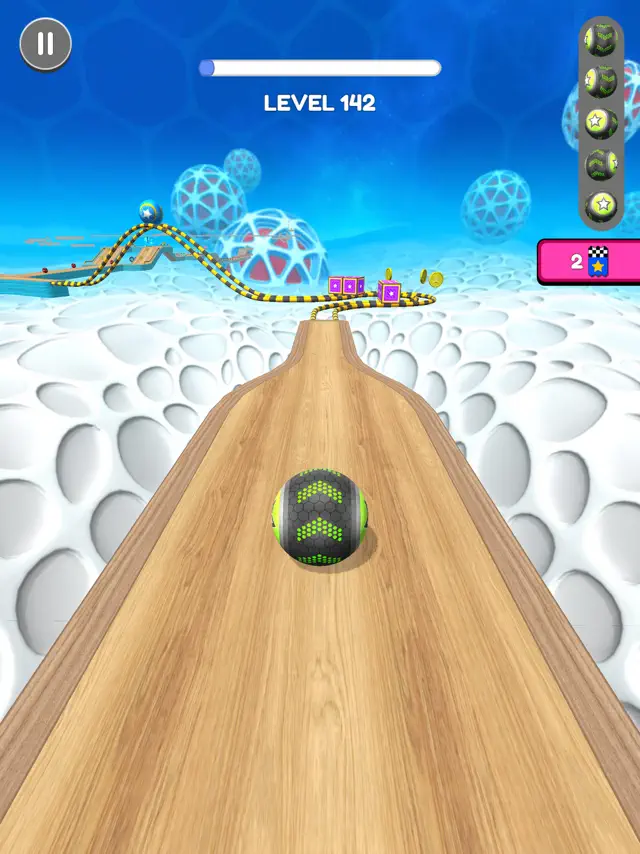
How Going Balls compares with Slope
Shared skill
Precise ball control, edge awareness and reading obstacles before the ball reaches them are useful in both games.
Level-based structure
Going Balls uses many discrete courses rather than a single endless run, so reaching the finish is a primary goal.
Extra systems
Miniplay describes coins and power-ups alongside obstacles and platforms. Those systems add route choices that classic Slope does not use.
Pacing difference
Slope continually raises pressure inside one run; Going Balls can teach an obstacle, reset the context at a new level and introduce another pattern.
What transfers back to Slope
Use the same habit of looking beyond the ball and reducing unnecessary steering. Ignore collection goals when returning to Slope, where survival and distance matter more than pickups.
Why level design changes your decisions
Going Balls is organized around discrete obstacle courses. That makes the finish line a concrete objective and allows each level to emphasize a particular combination of platforms, traps and movement challenges. Classic Slope instead keeps pressure inside a continuing run where survival and distance are the main measures of progress.
Because a Going Balls level can be learned, repeated attempts often become route optimization. In Slope, a stronger habit is to recognize categories of danger and adapt them to the current generated sequence rather than memorize one exact path.
Coins, power-ups and route choice
Coins and power-ups give Going Balls an extra layer of decision-making. A collectible can tempt you away from the most conservative line, which creates an explicit trade-off between reward and safety that classic Slope largely avoids.
For a Slope player, that is a useful way to practice discipline: decide before steering whether the optional reward is worth the positioning cost. When you return to Slope, the same principle becomes a question of whether a faster-looking line is worth reducing the margin available for the next obstacle.
What skills transfer back to Slope?
Edge awareness, measured steering and looking ahead transfer well between the two games. Both punish late recognition when the ball is already committed to a poor line. The strongest shared habit is to make fewer, earlier corrections instead of several large inputs after the danger is close.
Do not transfer the collection mindset itself. Slope does not ask you to chase coins or power-ups, so the best line is usually the one that protects survival, visibility and recovery space. Going Balls is therefore a partial mechanical match rather than a direct Slope substitute.
A first-session plan for Slope players
Start by ignoring optional collectibles and learn how the ball responds on flat platforms, turns and narrow bridges. Once the basic movement feels predictable, add coins and power-ups back into the route and notice when an optional pickup pulls you away from a safer line.
This order makes the comparison with Slope clearer. First you test shared ball-control skill; then you add the systems that make Going Balls different. If a mistake appears only after chasing a pickup, the problem is route priority rather than basic steering.