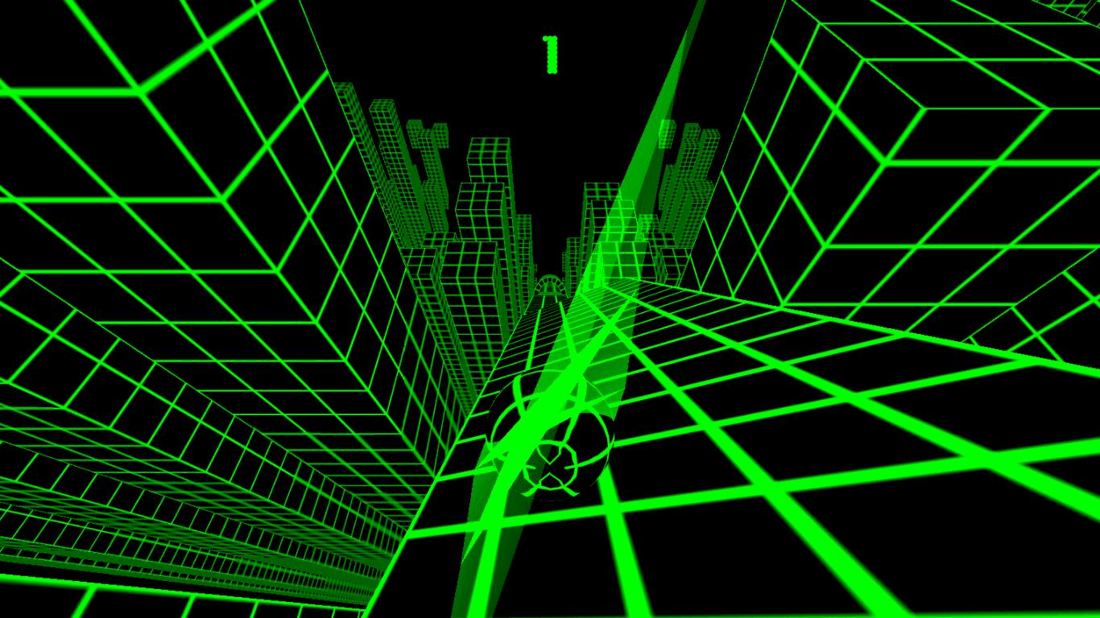
A reasonable dodge can become oversteering when the press lasts longer than the available floor allows. Break the move into separate decisions so you can see which part needs changing.
↔️One move has three moments
START THE PRESS
Choose a direction while the clear surface is still reachable. The ball needs space to change its position.
CHECK THE PASS
Watch the whole ball clear the corner. Do not judge only by its center or by the empty lane beyond the block.
END THE INPUT
Release when the required move is made. Then observe the path before adding another correction.
These moments are not equally spaced and there is no single tap length for every section. A wide offset needs more movement than a small lane adjustment. The useful habit is to make the end of a press deliberate instead of holding until the next hazard takes over your attention.
A steering decision uses platform width
Input sequence sketch: the marked path illustrates a move and release, not a measured in-game trajectory.
Read the sketch from the lower ball to the upper marker: start the input, watch the space you cross, then decide when to release. The floor left outside the move is room for the next correction. Use the same sequence whichever direction the actual route requires.
A correction clinic
🎯
Cleared the block, then fell
Keep the initial route choice, but try ending the press sooner on the next comparable section. If the ball still travels toward the edge after release, observe the carry before adding a small opposing input. Do not expect release to act as a brake.
🔁
Changed direction twice and hit red
You may have abandoned a route before the first move had room to finish. Review whether the second correction was needed or whether it came from watching the obstacle instead of the open surface. A later correction cannot undo the earlier approach instantly.
⏱️
Never reached the clear side
A tiny press is not automatically precise. If the side you chose was reachable but too far away for the time left, begin the move earlier. The problem may be the start of the move rather than its total duration.
Watch position change against a fixed reference
Use a platform edge as a reference while judging how much a press moves the ball.
Compare with the edge, not the towers
The camera and scenery move continuously, so a distant tower can be a poor reference for lateral handling. The floor beside the ball gives you a more direct comparison: is the side margin growing or shrinking while you press, and what happens just after release?
If the outside margin keeps shrinking after release, continue with sideways carry. Watch that trend before choosing the size of an opposing press; the ball reaching a useful position does not automatically finish the move.
🧪Try a small, controlled change
Use an open stretch
Choose the same steering pair for the exercise. Make a modest adjustment and release while the ball still has visible space on both sides.
Watch after release
Notice whether the ball’s path is still approaching an edge. Keep the observation separate from another key press so you can tell which input caused which result.
Apply it beside one obstacle
Aim to clear a block without spending all the remaining width. After the attempt, record whether your problem was late entry, long hold, or an unnecessary reversal.