The surface under you
Begin with the platform carrying the ball. Follow its left and right boundaries. This gives you the space available for the current move; distant empty space cannot help until you can reach it.
The screen contains more green lines than usable road. Reading the course means finding the connected surface you can reach next, then checking the obstacles and edges that limit the approach.
Begin with the platform carrying the ball. Follow its left and right boundaries. This gives you the space available for the current move; distant empty space cannot help until you can reach it.
Locate the red block or missing floor that interrupts that surface. Compare both possible sides with the platform edges. An opening that exists visually may still be too far across for a late move.
Trace where the chosen route goes after the obstruction. The next platform may be offset. You need a path onto its floor, not just a path past the nearest red face.
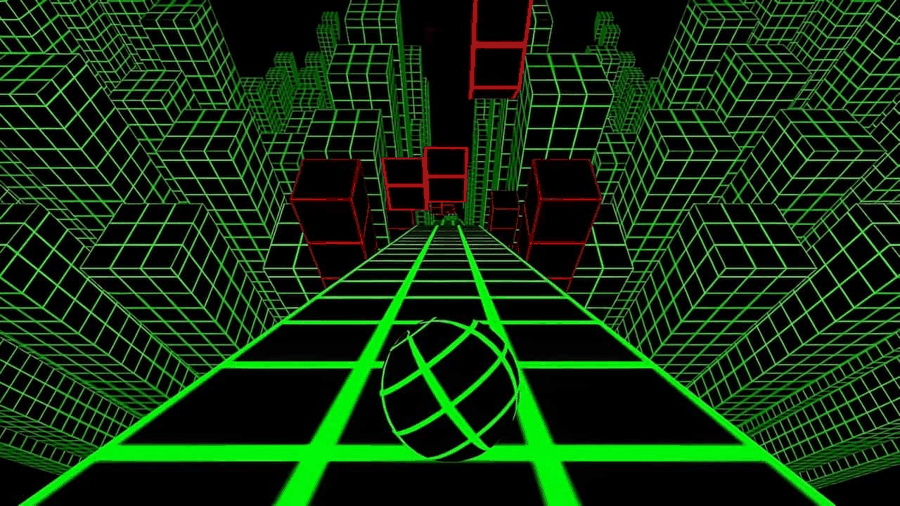
Follow the floor grid out from the ball. Where it stops or changes direction, identify the next piece of ground before committing to a wide move. A distant tower can overlap that shape from the camera’s viewpoint, so check the visible platform edges rather than following any bright green line.
Notice where one platform stops and the next begins. Carry that relationship into the next attempt, even when the pieces appear in a different arrangement. You are learning how surfaces connect, rather than memorizing a particular opening.
The question order matters. A block can capture your attention while a gap behind it decides whether the route is viable. Look beyond the object briefly, then return to the clearance you need now. The attention guide describes that shift without asking you to stare at one fixed spot.
| Cue | Useful meaning | Do not assume |
|---|---|---|
| Outer platform edges | Current lateral margin | That the screen center is the platform center. |
| Red surfaces | Collision danger | That clearing a flat face also clears its corner. |
| Tunnel opening | A corridor to align with | That the corridor beyond is empty. |
| Visible next platform | Potential receiving floor | That its full width is reachable from your current approach. |
Try describing the route before naming a key: “The next platform is left of this one, and the block leaves space on its right.” Now check whether that pass still leads onto the receiving floor. If it does not, revise the route before making the move.
Try this as a mental check on an ordinary run. You do not need to pause the game or calculate angles. If the problem is a specific feature, use the focused guides below.