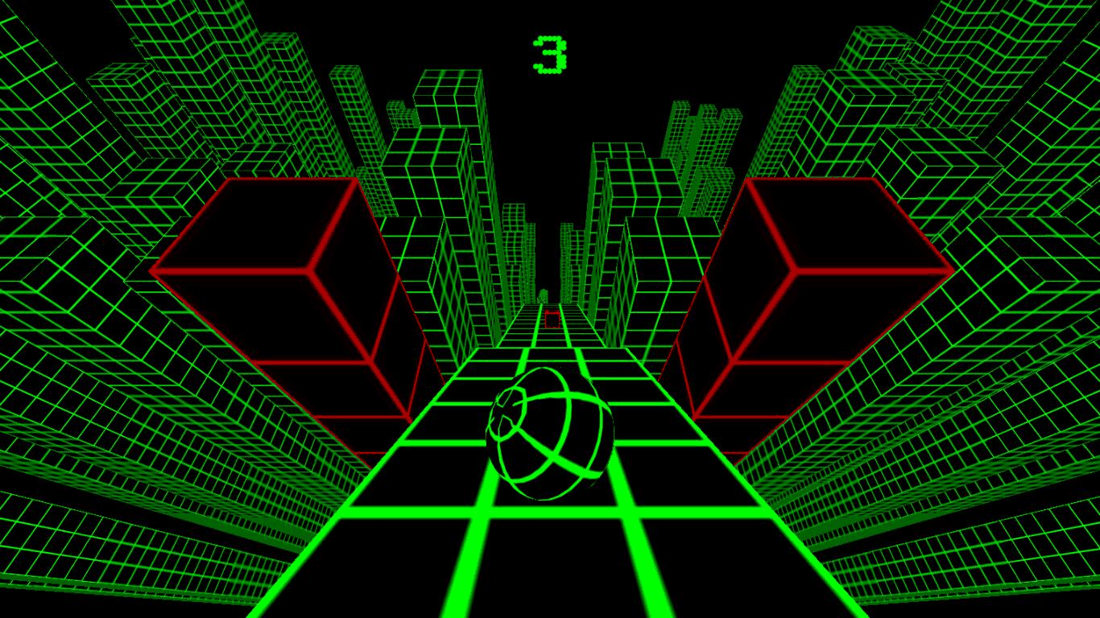
“Stay in the middle” and “move early” are useful until the next platform asks for something else. Good advice needs a condition. Use these priorities to decide which rule deserves your attention right now.
🧭Put the decisions in this order
01
Keep a reachable floor. First find a route that still has somewhere to land or roll. A perfect line beside a block is irrelevant if the platform ends under it.
02
Clear the whole obstacle. Judge space for the ball, including a block’s corner. An attractive open lane ahead does not mean the ball has already reached it.
03
Keep room for what follows. Once immediate danger is handled, avoid spending all the platform width on one dodge. Save a margin for the next change of direction.
When common advice conflicts
Treat each rule as a conditional tool
Tip
Useful when
Change the plan when
Stay near the middle
An open, straight section leaves equal escape room
The receiving platform or safe corridor is offset.
Move early
The route is readable and you can commit with confidence
The next section is still hidden; early guessing may be worse.
Use small taps
You need a minor position change
A large offset requires a sustained move begun sooner.
Look farther ahead
The nearby path is stable
A red corner or edge needs an immediate clearance check.
The useful moment is when the route becomes clear enough to choose. If the next floor is visible, use the approach to move into position. If an obstacle hides the continuation, keep room for a later choice instead of making a wide move toward an unseen exit.
A route can solve one problem and create another
Red obstacles and the platform boundary are separate limits in the same scene.
Check the place you will leave the ball
Suppose the left side of a block is open. The next question is whether moving there leaves enough usable floor after the pass. If the following connector is on the other side, a very wide dodge can turn an easy clearance into a rushed recovery.
Use block clearance to judge the pass and platform margin to judge its exit. When those checks favor different sides, choose the route that still reaches the next platform.
Three situations worth recognizing
⚡
A late surprise
If the block is already close, look for the shortest reachable clear space. Do not add a second change of direction merely because the first move felt uncomfortable. After the run, ask where the route became visible and why you missed it.
🚪
A clear but narrow approach
Reduce unnecessary weaving before entry. The important work may be to arrive with a settled path, not to perform another correction inside the small space. Use the tunnel sequence for enclosed sections.
📝Write a rule you can actually test
Use this sentence: “When I see ___, I will try ___, and I will check ___ after the run.” Fill it with an observable feature and one input change. “When I clear a block but keep falling outside, I will release earlier and check whether floor remains beside the ball” is testable. “I will concentrate harder” is not.