Home/The Slope game glossary
The Slope game glossary
These are practical words used by the guides to describe what you can see and change during a run. They are not extra controls or mathematical definitions of slope.
Find a group of terms
A–C · Approach, carry, clearance
- Approach
- The section before a feature where you prepare the ball’s path. For a tunnel, that means the floor leading to the opening, not just the instant of entry. See the three tunnel stages.
- Carry
- The sideways travel you observe after a steering change. It describes the motion you see, not a measured physics constant. The momentum guide separates carry from current position.
- Clearance
- Enough space for the whole ball to pass an obstacle or boundary. A line through the center is not a complete clearance check. See corners and red blocks.
- Correction
- An input made to change a developing path. A correction can help, but an unnecessary reversal can also create a new problem. The useful question is which observed trend the input is meant to change.
F–I · Floor, focus, input
- Floor / usable surface
- The connected platform area the ball can roll on or reach next. A green tower is scenery, even though its color matches the route. Use the floor-reading panels to distinguish them.
- Focus
- In a browser check, the target receiving keyboard activity. In a gameplay discussion, visual attention. These are different meanings: concentrating on a game does not prove its canvas has keyboard focus.
- Gap
- Empty space between usable pieces of track. A gap calls for a receiving-platform check. It is different from a red block, where the floor may continue but a collision object occupies the route.
- Input
- An action delivered to the game, such as Left Arrow or A. Input is not the same as the resulting position. A long press, a release, and a later reversal belong to different moments.
Put the vocabulary in a real scene
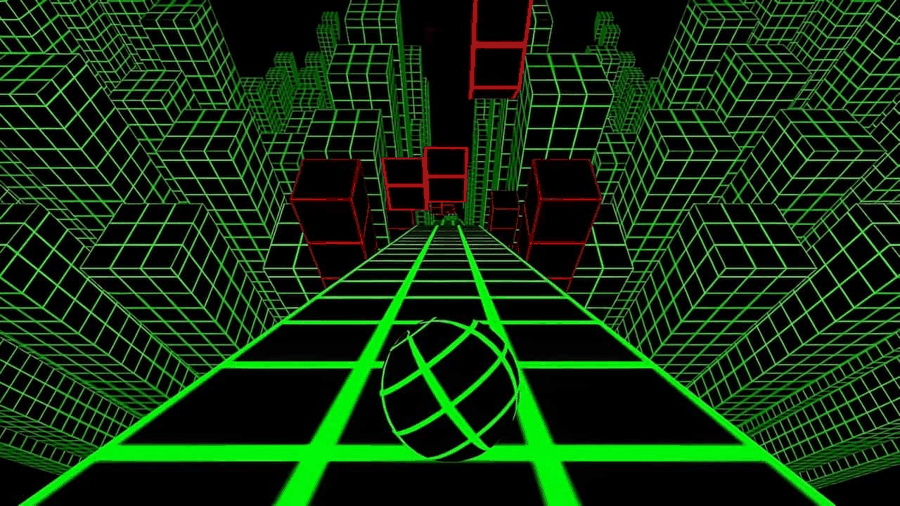
Describe relations, not just objects
“Near the block” names a place. “Clearing its right corner with little outside margin” names the clearance and the floor left afterward. Use that fuller description when you review a run: it points to a specific check rather than a vague feeling that the section was difficult.
L–M · Landing, line, margin
- Landing
- The arrival onto receiving ground after leaving a piece of track. The original game has no manual jump key; use the takeoff and landing sequence to review the approach.
- Line
- A proposed path through the current feature and toward the next floor. A useful line includes the exit. It is not a permanent left, middle, or right lane assigned to every run.
- Margin
- The usable floor left beside the ball for a pass or later correction. The relevant margin changes with the path. The narrow-platform guide explains why screen center is not enough.
P–R · Platform, release, reset
- Platform / receiving platform
- A piece of the course. “Receiving” names the piece you are trying to reach next, distinguishing it from the floor currently carrying the ball.
- Release
- The moment you stop holding a steering key. It ends that input; it does not act as a brake or return the ball to a default position.
- Restart / Reset player
- A restart inside the game begins a new attempt. Reset player is the home-page control that reloads the page and ends the runtime. Use the latter when you need a fresh loading session.
S–T · Score, stutter, tunnel
- Score
- The result displayed by the particular game. Do not silently convert it to distance or compare it across different titles. See fair score comparisons.
- Stutter
- Uneven visible motion, including pauses or irregular jumps in the scene. It is a performance symptom, unlike smooth gameplay that simply feels faster. Use the symptom triage.
- Tunnel
- An enclosed section of the original course. It is also part of the name of the separate game Slope Tunnel; use context to tell the course feature from the game title.